
Bedtime Was a War. Now It Runs Itself.

For a long time, bedtime in our house was a negotiation. Not a blowup, just the slow grinding kind: someone needed water, someone couldn’t find their thing, someone had one more very important thought to share before the lights went out. Most nights it ran forty-five minutes past when it was supposed to end. We were done. The kids were wound up. Everyone was a little resentful.
Then, over several months, something shifted. Now bedtime happens. The kids move through it mostly on their own. We’re still there, but we’re not managing each step anymore. The routine, somehow, runs itself.
That’s a flywheel. And once you see it in your family life, you start spotting it everywhere.
What a Flywheel Actually Means for a Family
The flywheel is a physics concept that ended up in business books, which is an unfortunate journey for a useful idea. Stripped down: a heavy wheel takes real effort to get spinning, but once it has momentum, it keeps going with very little input. Each push adds to the last.
Family routines work the same way. The startup phase is genuinely hard and consistency feels pointless when you’re in the middle of it. The momentum builds quietly anyway. Eventually the routine starts pulling itself forward.
Nobody tells you that part. Most parenting advice is about how to design the perfect bedtime system. The flywheel doesn’t care about perfect design. It cares about repetition.
How Bedtime Got Easier Without Us Doing More
We kept the routine simple and identical every night. Same order, same steps, no variations.
Pajamas, brush teeth, pick a book, lights out. That’s it.
The first few weeks felt like nothing was sticking. The kids needed prompting at every step, and there were plenty of nights where it was faster to just do it for them. We mostly resisted that.
Around week six, they started anticipating steps without being reminded. By week ten or so, they were running through the whole sequence while we were still in the next room finishing up. Not because we trained them in some deliberate way, just because the routine had become the expected shape of the evening. One night we realized we hadn’t given a single reminder. They were already brushing their teeth.
We didn’t get better at bedtime. Bedtime got better at itself.
The Same Thing Happened with Meals
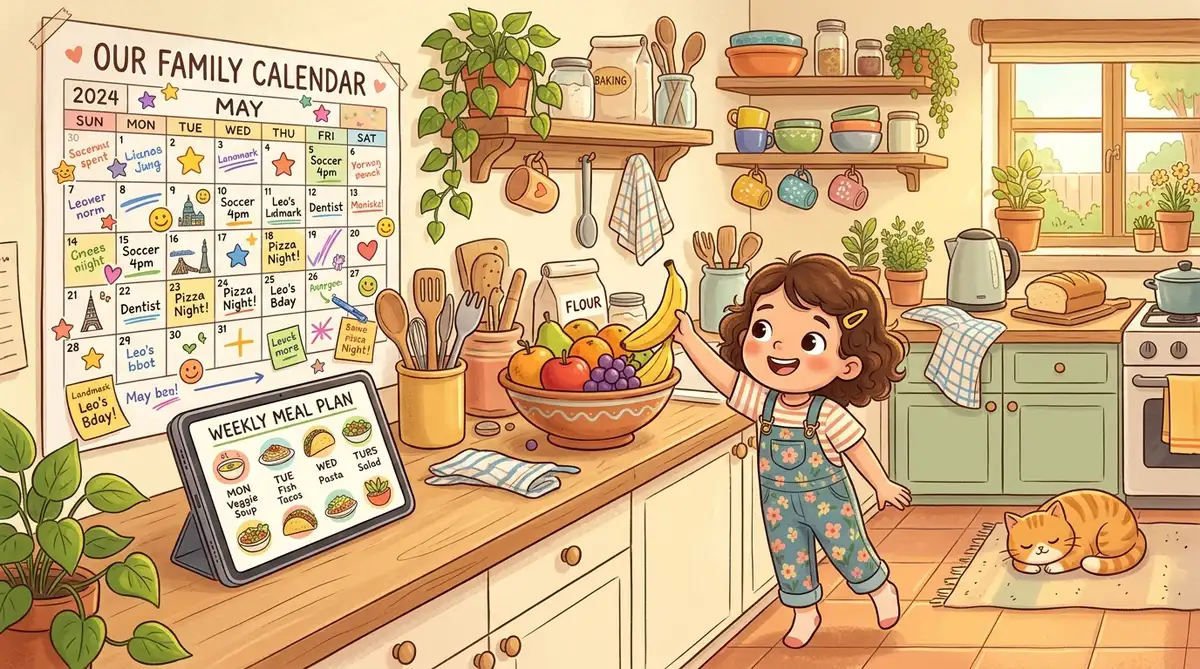
We started using AI to help plan dinners for the week. Nothing elaborate, just a short list of meals we could realistically make with what we already had on hand. That cut the daily “what are we even eating?” friction enough that actually cooking felt manageable.
With dinner happening at a predictable time in a predictable way, the kids started drifting toward the kitchen. Watching. Asking questions. Helping with things they’d seen us do enough times to try themselves. Over a few months, a couple of dishes became theirs. They make them without being asked.
The AI didn’t build that habit. The consistency did. The AI just removed enough friction to make consistency possible in the first place.
Family Tip
The One-Small-Thing Approach
This sounds deceptively simple, because it is.
Pick one routine. Make it the same every day. Don’t try to fix the whole household at once.
We didn’t architect a family system. We just stopped changing bedtime. Same time, same order, same energy in the room. That was the whole intervention. The compounding did the rest.
Consistent and small beats ambitious and irregular in almost every family context we’ve tested this on. The flywheel doesn’t reward big bursts of effort. It rewards small, boring, reliable pushes.
When the Flywheel Stalls
It will stall. Vacation disrupts it. A sick week disrupts it. The holidays wreck it entirely.
What we’ve found is that recovery is faster than the original build. The flywheel isn’t gone when it stalls, it just slows down. A few nights of returning to the same routine and it picks back up considerably faster than it took to spin up the first time.
The instinct is to treat a broken routine like a failure and start over from scratch. It’s not broken, it’s paused. Resume where you left off.
Honest Timeline: Months, Not Days
It took close to three months before bedtime felt genuinely easy. Not three days. There were nights in the middle that felt like nothing was working, nights we skipped the routine entirely because someone was sick, or we had people over, or we just didn’t have it in us.
It still compounded. Slowly, but it did.
The flywheel doesn’t require perfect execution. It requires enough consistent repetition that momentum builds faster than it dissipates. You can miss nights. You can have bad weeks. The key is returning to the same shape of routine when you do.
We’re not parenting experts and we’re not selling a system. We’re just a family that got tired of bedtime being hard and stayed consistent long enough for it to get easier.
If you’re somewhere in the middle of the grinding phase right now, where every evening feels like starting from zero, that’s exactly where we were. Pick one thing. Keep it the same. Give it more time than feels reasonable.
The flywheel catches eventually. Ours did.