
The Boredom Experiment: What Happens When You Stop Entertaining Your Kids
It started because I was exhausted.
Both kids were home, it was a rainy Tuesday, and I’d run out of ideas. No craft projects queued up. No field trips planned. I was about to pull up YouTube Kids just to buy myself 30 minutes when I thought: what if I just… didn’t?
What if I let them be bored?
That one decision turned into a three-week experiment that changed how we think about downtime, creativity, and what our kids actually need from us.
The Instinct to Fill Silence
Parents have this reflex. A kid says “I’m bored” and something in your brain screams FIX IT. Pull out the art supplies. Suggest a game. Turn on a show. Anything to stop the whining.
I was the worst about this. Every quiet moment felt like a failure. If the kids weren’t doing something “productive” or at least entertained, I was dropping the ball. That instinct was doing more harm than good.
Boredom isn’t a problem to solve. It’s a space where something interesting might happen, if you can resist the urge to fill it.
Week One: The Complaining Phase
I won’t sugarcoat this. The first few days were rough.
“I’m bored.” “There’s nothing to do.” “Can I have the tablet?” “This is the worst day ever.” Our son said some version of “I’m bored” at least fifteen times on the first day. I counted.
We kept it simple. “You’ll figure something out.” Then we went back to what we were doing. No suggestions. No rescuing. Just calm confidence that they’d find their way.
The Hardest Part
By day three, something shifted. The complaining didn’t stop completely, but it got shorter. “I’m bored” became more of a passing statement than a demand for action. And in the gaps between complaints, things started happening.
Week Two: The Invention Phase
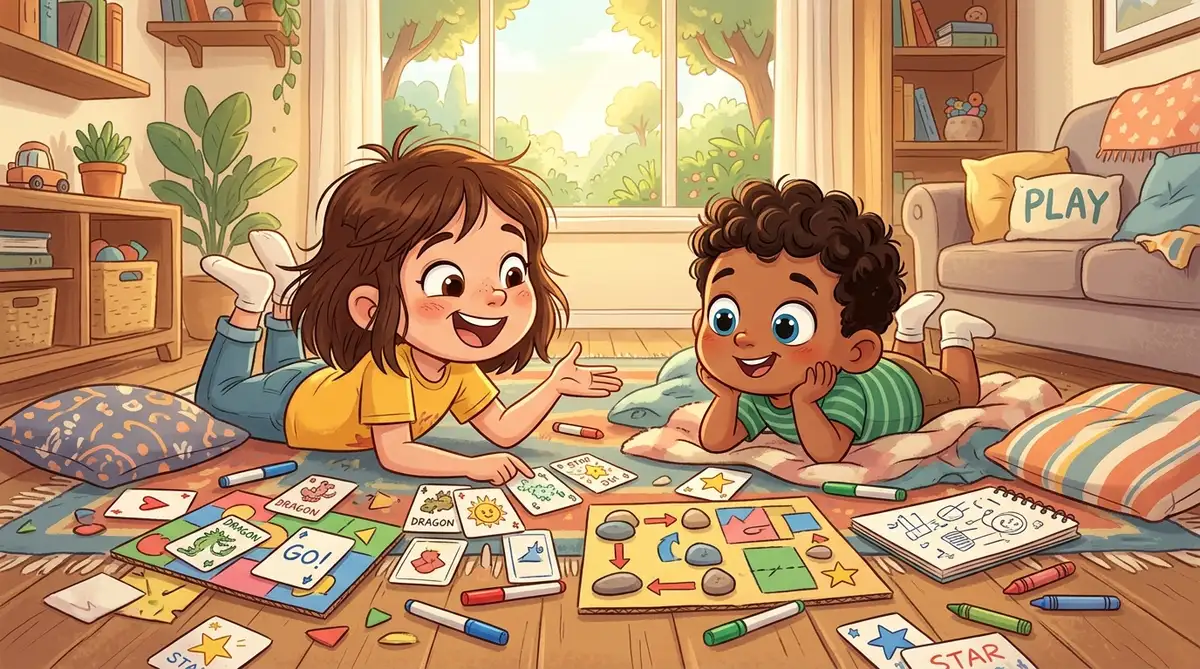
Our daughter invented a card game.
She took a regular deck of cards, made up her own rules involving matching, bluffing, and a “wild cat” card she drew on a sticky note, and taught it to her brother. They played it for two hours. Two hours. Without a single fight.
The rules didn’t entirely make sense. The scoring system changed mid-game. But they were negotiating, explaining, adapting, and problem-solving, and they were completely absorbed.
Our son, meanwhile, started building. He dragged every blanket and pillow in the house into the living room and constructed what he called a “fort city.” It had rooms, a storage area for snacks, and a password to get in (the password was “cheese,” which he thought was hilarious).
The fort lasted a week. They added to it every day. It became a base for imaginative games, a reading nook, and eventually a small business when our daughter started charging admission (one cookie per visit).
Week Three: The Deep Project Phase
This is where things got really interesting.
Our daughter started a comic book. Not a single page, a series. She planned out characters, storylines, and a production schedule (three pages a week). She’s still working on it weeks later. The art has gotten noticeably better with each issue.
Our son discovered that he could build working circuits with a kit that had been sitting in his closet for months. Something about having nothing else to do made him finally open the box. He spent an entire afternoon making a buzzer circuit and then a light-up quiz board.
Neither of these projects was assigned. Nobody suggested them. They emerged from empty space.
What We Noticed as Parents
The skills that showed up weren’t the ones I expected.
Negotiation. The card game required constant rule-making and compromise. “That’s not fair” turned into “okay, how about this instead.”
Sustained focus. When kids choose their own project, they stick with it. Our daughter worked on her comic for 90 minutes at a stretch, something no worksheet has ever achieved.
Planning. The fort city had a blueprint. Our son drew it on paper before building. He’s never done that for anything we’ve assigned him.
Resourcefulness. When they couldn’t find what they needed, they improvised. The “wild cat” card was a sticky note. The fort’s “door” was a towel clipped to a chair.
When Boredom Works (and When It Doesn’t)
This isn’t a “never entertain your kids” manifesto. There are times when a kid is genuinely struggling, not just uncomfortable, and needs engagement. If a child is anxious, lonely, or going through something hard, boredom isn’t the answer.
But for the everyday “I’m bored” that happens on a regular Tuesday? That’s not a crisis. That’s an opportunity.
The Boredom Test
What the Research Says
Psychologists have been saying this for years. Unstructured time is where creativity develops. Dr. Teresa Belton’s research at the University of East Anglia found that children who experience boredom develop better internal motivation and creative thinking skills than children whose time is constantly structured.
The American Academy of Pediatrics recommends unstructured play as essential for healthy development. Not as a luxury or a break from learning, but as the primary way young children develop executive function, creativity, and social skills.
We didn’t read the research first. We stumbled into this out of exhaustion. But knowing the science backs it up makes it easier to hold the line when the “I’m bored” chorus starts.
How This Changed Us
We still plan activities. We still do co-op and sports and craft projects. But we stopped filling every gap. Weekends have more open space now. Afternoons after co-op aren’t scheduled with a second activity.
The surprising result isn’t that our kids became more creative (though they did). It’s that our house became calmer. Less rushing. Less “we have to be somewhere in 20 minutes.” More slow mornings and aimless afternoons that turn into something unexpected.
The card game is still in rotation, by the way. The rules have evolved through at least six versions. Our daughter is thinking about making a “real” version with printed cards.
She’s not bored anymore. She’s busy.
Try the Experiment
Pick one afternoon this week. No screens, no planned activities, no suggestions. Just tell your kids 'you'll figure it out' and see what happens. The first 20 minutes will be hard. What comes after might surprise you.
Share this article
If this helped, pass it along.