
Minecraft as a Math Textbook: The Unlikely Education of a 9-Year-Old
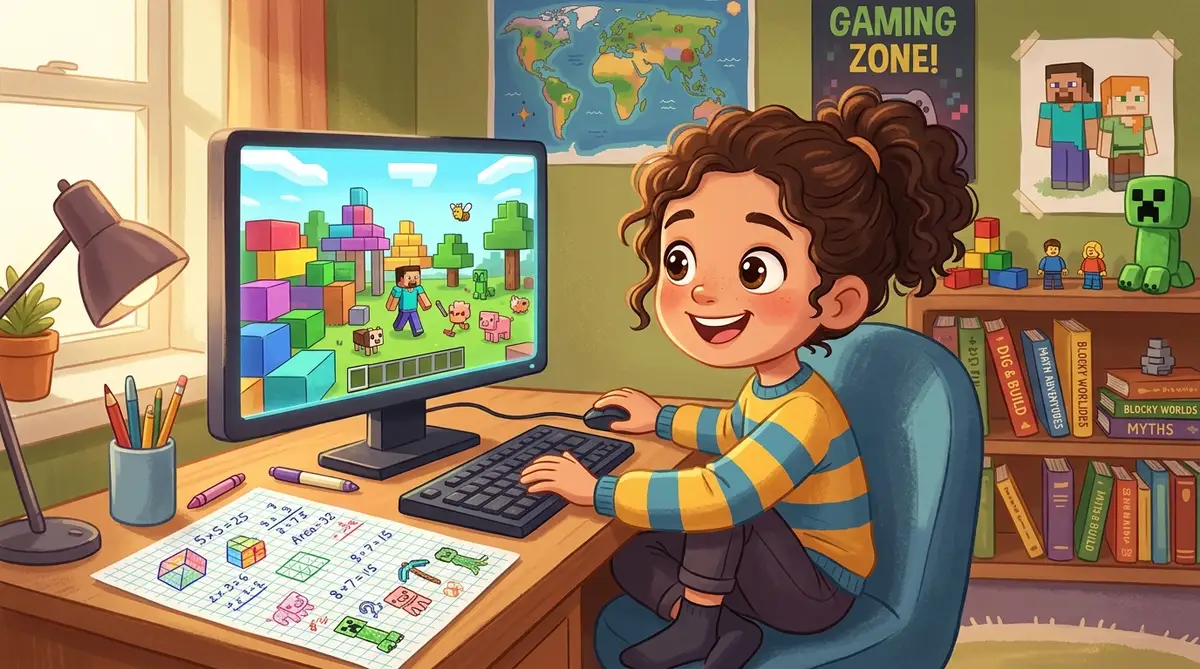
We tried three different math curricula before giving up. Workbooks. Online programs. That one app everyone recommends. Our son would do about ten minutes of any of them before his eyes glazed over and he asked if he could play Minecraft instead.
So we let him play Minecraft.
Six months later, he understood binary arithmetic, could calculate area and perimeter faster than I can, knew how to do unit conversions, and had a working grasp of supply and demand economics. All from a video game.
This is the full story of what he learned, how it happened, and why we stopped fighting screen time for this particular game.
The Redstone Calculator: Binary Arithmetic at Age 8
This was the moment that made us pay attention.
Our son found a YouTube tutorial on building a calculator in Minecraft using redstone, the game’s version of electrical wiring. Redstone is simple: a signal is either on or off, 1 or 0. To build a calculator out of on/off signals, you have to understand how those 1s and 0s represent regular numbers.
He watched the tutorial six times. He paused it constantly, going back and forth between the video and his build. He started asking questions like “why does 1010 equal ten?” and “what happens if you add 1 and 1 in binary?”
Within a week, he could convert between binary and decimal in his head for numbers up to 31. He’s eight. I didn’t learn binary until college.
What He Actually Built
The important part: nobody assigned this. Nobody said “today we’re learning binary.” He wanted to build a cool thing in his game, and math was the tool he needed to get there.
Zoo Enclosures: Area and Perimeter Without a Worksheet
Our son went through a phase where he wanted to build a zoo in Minecraft. Every animal needed its own enclosure, and he had opinions about how big each one should be.
“The cows need a bigger area than the chickens because cows are bigger.” Okay, how much bigger? He started counting blocks. Each block is one square meter in Minecraft, so the math was built right in.
He figured out on his own that a 10x10 pen has 100 square meters of space but only uses 36 blocks of fencing (the perimeter). Then he tried a 5x20 pen, same area but 50 blocks of fencing. “That’s dumb, it wastes fence,” he said. He’d just discovered that squares are more efficient than rectangles for enclosing area.
This turned into a 45-minute math session. Voluntary. He was optimizing his zoo layout and didn’t realize he was doing math the entire time.
The Parent Move
Crafting Recipes: Ratios and Proportions
Every item in Minecraft has a recipe. A cake requires 3 wheat, 2 sugar, 1 egg, and 3 milk. If you want to make 5 cakes, you need to multiply everything: 15 wheat, 10 sugar, 5 eggs, 15 milk.
Our son does this math constantly. He doesn’t think of it as math. He thinks of it as “figuring out how much stuff I need.” But when I showed him a ratio problem from a workbook, he said “oh, that’s just like crafting recipes.” He solved it in seconds.
The game also teaches resource optimization. You have limited inventory space, so you have to decide what to carry. Is it worth bringing 64 iron ingots on this trip, or should I bring 32 iron and 32 gold? That’s opportunity cost, even if he doesn’t know the term.
The Minecraft Marketplace: Economics
Minecraft has a marketplace on some servers where players trade items with each other. Our son plays on a family-friendly server where kids set up shops and negotiate prices.
He learned supply and demand the hard way. He spent days mining diamonds, set up a shop selling them for what he thought was a fair price, and nobody bought any. “Everyone has diamonds,” another player told him. Too much supply, not enough demand. He lowered the price and still couldn’t sell.
So he switched to selling something rare: enchanted books. Fewer players made them, so he could charge more. He figured out basic market economics from trial and error.
He also learned about loss leaders (selling cookies cheap to get people to visit his shop, where they’d buy more expensive items), bundling (diamond sword + enchanted book for a package price), and customer service (being nice to buyers so they come back).
None of this was planned. He was just playing a game with his friends.
What Minecraft Doesn’t Teach
I’m not going to pretend Minecraft is a complete math education. There are real gaps.
It doesn’t cover long division, fractions with unlike denominators, negative numbers, or anything involving graphs. The arithmetic is all positive whole numbers. The geometry is all right angles and straight lines.
Our son fills some of these gaps through other interests. Cooking involves fractions. Building with Legos involves spatial reasoning and angles. And yes, sometimes we pull out a workbook or an app for specific skills he needs.
The difference is that Minecraft gave him confidence. He doesn’t say “I’m bad at math” anymore. He says “I haven’t learned that yet,” which is a completely different mindset.
- Binary and decimal conversion (redstone circuits)
- Area and perimeter (building enclosures)
- Multiplication and scaling (crafting recipes in bulk)
- Ratios and proportions (resource planning)
- Basic economics (marketplace trading)
- Optimization (inventory management, efficient building)
- Estimation (resource gathering, trip planning)
What We Did as Parents
The most important thing we did was get out of the way. When he was building the redstone calculator, we didn’t turn it into a lesson. We didn’t make worksheets about binary to “extend the learning.” We asked questions when he wanted to talk about it and left him alone when he didn’t.
We also paid attention. When he mentioned that the cow pen needed to be bigger, we asked “how much bigger?” instead of saying “finish that and come do math.” The conversation happened naturally because we were listening.
And we played Minecraft with him sometimes. Not to teach, just to be there. He showed us his builds, explained his logic, and we got to see the math happening in real time.
For Parents Who Don't Game
The Screen Time Conversation
We used to fight about screen time. Minecraft was “just a game” and games were limited to an hour a day. Then we watched our son learn binary arithmetic from it.
Now we evaluate screen time by what’s happening on the screen, not how long it’s been on. An hour of Minecraft where he’s designing, building, and calculating is different from an hour of passively watching random YouTube videos. Both happen in our house. We just stopped treating them the same.
The binary calculator took three weeks of daily work. If we’d capped his time at one hour, he might never have finished it. Some projects need space to breathe.
The Uncomfortable Truth
Here’s the part that’s hard to say out loud: our son learned more math from Minecraft in six months than he learned from any formal curriculum we tried. That’s not a knock on curricula. It’s an acknowledgment that motivation matters more than materials.
When a kid wants to build something and math is the barrier between them and their goal, they’ll learn the math. Not because it’s assigned, but because it’s useful. That’s the whole idea behind unschooling, and Minecraft is the most vivid proof we’ve seen.
Watch Before You Teach
Next time your kid is playing a game, sit with them for 20 minutes. Don't direct anything. Just watch and ask questions. You might be surprised by what they're learning.
Share this article
If this helped, pass it along.