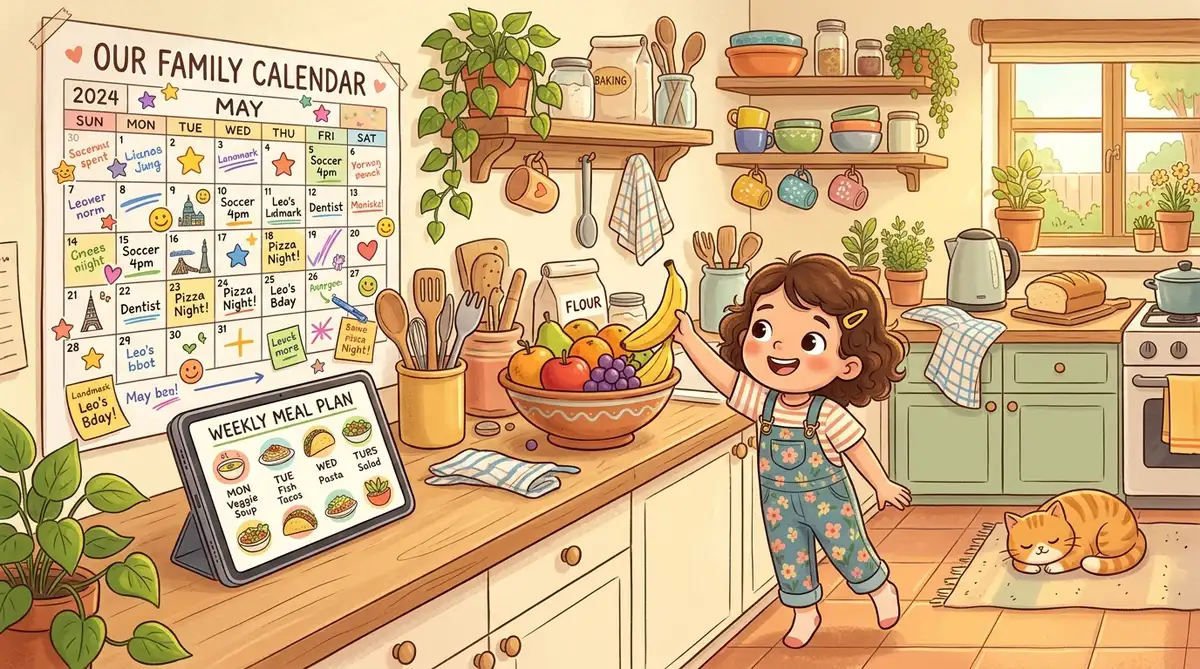

Our Sunday AI Routine: How We Plan the Whole Week in 30 Minutes

Monday mornings used to be: what’s for dinner? Do we have ingredients? What’s happening? Where’s the soccer stuff? No idea, scrambling, everything reactive.
Now: it’s planned. Dinner decided. Groceries bought. We know what’s happening.
One Sunday. 30 minutes. Everything else is automatic.
The Ritual That Changed Our Week
Every Sunday around 10 AM (after coffee, before focus slips), we sit with a laptop for 30 minutes planning the entire week. Not uptight. Just “let’s figure out what’s happening so nobody’s surprised.”
Three AI prompts. One grocery list. Done.
Our son used to ask “what’s for lunch?” constantly. Our daughter would remember Thursday at 9 PM that a friend visits Friday. I’d stand at the fridge at 5 PM with zero ideas and no ingredients.
Now I open the Sunday document. Everything’s there.
The Three Prompts (And Why They Work)
Prompt 1: Meal Plan
Create a weekly meal plan for a family of 4. Monday through Sunday. Include breakfast, lunch, and dinner. We have a 9-year-old boy who likes Minecraft and video games, and an 8-year-old girl who’s hands-on and creative. Include meals the kids will actually eat (not too adventurous). Meals should be: easy enough to prepare on busy days, use overlapping ingredients to minimize shopping, include at least one “fun” meal (tacos, pizza night, breakfast for dinner). Format as a simple list.
Run it. Get back a full week of meals that actually work.
Prompt 2: Weekly Schedule
Create a weekly schedule/planner for a family. Include: morning routines (wake up, breakfast, school prep), after-school time, dinner, evening routines, bedtime. Include space for kids’ activities (one or two per week). Note: 9-year-old has [activity], 8-year-old has [activity]. Parent works [schedule]. Format as a simple overview we can reference quickly.
You get back a visual of the whole week. Who’s where. When. What needs to happen.
Prompt 3: Grocery List
Create a grocery list based on this week’s meal plan: [paste the meal plan]. Organize by grocery store section (produce, dairy, etc.). Include quantities. I’ll check off what we already have.
You get a complete list organized by store layout. Takes 15 minutes to shop instead of 45 because you’re not wandering around going “did we need milk?”
**Your Sunday planning prompts:**

**Meal Plan:**
Create a weekly meal plan for a family of [family size]. Monday through Sunday. Include breakfast, lunch, and dinner. We have a [AGE]-year-old [interests] and a [AGE]-year-old [interests]. Include meals kids will actually eat. Meals should be: easy on busy days, use overlapping ingredients, include at least one "fun" meal. Format as a simple list.

**Weekly Schedule:**
Create a weekly planner for our family. Include: morning routines, after-school time, dinner, evening routines, bedtime. Include kids' activities on [days]. Note key commitments: [work, appointments, etc.]. Format as a simple overview.

**Grocery List:**
Create a grocery list based on this meal plan: [paste your meal plan]. Organize by store section. Include quantities. I'll check what we have.
What Actually Gets Generated
The meal plan usually looks like this:
Monday: Spaghetti with garlic bread and salad Tuesday: Tacos (kids can customize their own) Wednesday: Chicken stir-fry with rice Thursday: Pizza night (frozen is fine, kids help) Friday: Fish sticks with sweet potato fries and steamed broccoli Saturday: Breakfast for dinner (pancakes, scrambled eggs, toast) Sunday: Slow cooker chili
Every single meal is something we’ve made before or know we can make. No surprises. No “I don’t like that” at dinner time because the kids literally helped plan it (we ask them what they want included when we’re generating).
The schedule usually captures:
7:00 AM: Wake up, breakfast prep 8:00 AM: Get ready for school 3:00 PM: Pick up, snack, homework 5:00 PM: Dinner prep and cooking 6:00 PM: Eat together 7:00 PM: Evening activity (screens, crafts, outside) 8:00 PM: Bedtime routine starts 9:00 PM: Kids asleep
With specific notes: “Tuesday: daughter has activity from 3:30-4:30” and “Wednesday: son has soccer, we eat early.”
The grocery list becomes organized like:
Produce: Lettuce, tomatoes, onions, garlic, carrots, potatoes Dairy: Milk, eggs, cheese, yogurt Meat: Chicken, ground beef, fish, ground turkey Pantry: Pasta, rice, beans, oil, spices Frozen: Vegetables, stir-fry mix, pizza, fish sticks
Quantities included. You know you need 2 lbs chicken, not just “chicken.”
- Set aside 30 minutes Sunday morning (coffee helps)
- Run the meal plan prompt
- Run the weekly schedule prompt
- Copy your meals to the grocery list prompt
- Review the full week and adjust anything that doesn’t work
- Go grocery shopping with the list (organized by store section)
- Tack the meal plan somewhere visible (fridge, kitchen tablet, wherever)
- Reference it every morning so there are no surprises
How This Evolved Over Time
First week: we followed the plan exactly. It felt rigid.
Second week: we tweaked one dinner (already eating out), shifted it to Wednesday.
Third week: we asked the kids, “What one meal do you want?” They picked. Suddenly invested.
Now, every Sunday: “What one meal must be in there?” They pick. We weave it into the AI plan.
Our son picks Minecraft-themed pizza (he decorates his slice).
Our daughter picks something she helps make. Last week: cookies for snack. We added flour and sugar to the list.
The Mental Space It Freed
The secret: plan Sunday, no planning other days.
No 5 PM “what’s for dinner?” No fridge staring. No “do we have ingredients?” No Thursday night panic about Friday.
It’s done. You execute.
I gained 1-2 hours per week back. Not time saved. Cognitive load removed.
Sounds small. It’s not.
When the Plan Breaks (And That’s Fine)
Plans change. Soccer reschedules. Friends invite you out. You find different ingredients.
The plan is a map, not a contract. Deviate. Skip meals. Swap Tuesday and Wednesday.
Most weeks we follow it 80-90% because it’s actually good. Meals work. Schedule makes sense. It doesn’t fight reality.
When something changes, we adjust the plan and grocery list, not vice versa.
The Bonus: Cooking Becomes Easier
Know Monday is spaghetti, you can prep Sunday (boil water, make sauce). Know Thursday is pizza, kids help Thursday afternoon.
No surprises means you plan the cooking. Cooking becomes less chaotic.
Thursday pizza has become ritual. Kids expect it. It’s an event, not scramble.
Getting Everyone Bought In
Sunday morning doesn’t work? Try Sunday evening, Saturday morning, or Friday night. Time doesn’t matter. Consistency does.
Ask kids what they want included. This isn’t a chore to watch. It’s planning that affects their whole week. Let them voice it.
Our son started asking “can we check the plan?” Now he anticipates favorite meals instead of being surprised.
Our daughter looks forward to shopping because she knows we’re buying ingredients she likes.
This same principle works for cooking with kids (every meal becomes a teachable moment) and for using AI to generate daily tasks. Read: Teaching Kids to Cook with AI and Read: Automate Family Life with AI for more.
Try it this Sunday. Grab a laptop, coffee, and 30 minutes. Run the three prompts. See what you get. Most likely: you’ll never go back to winging it.
Share this article
If this helped, pass it along.