
Teaching Kids to Cook with AI (Without Losing Your Mind)
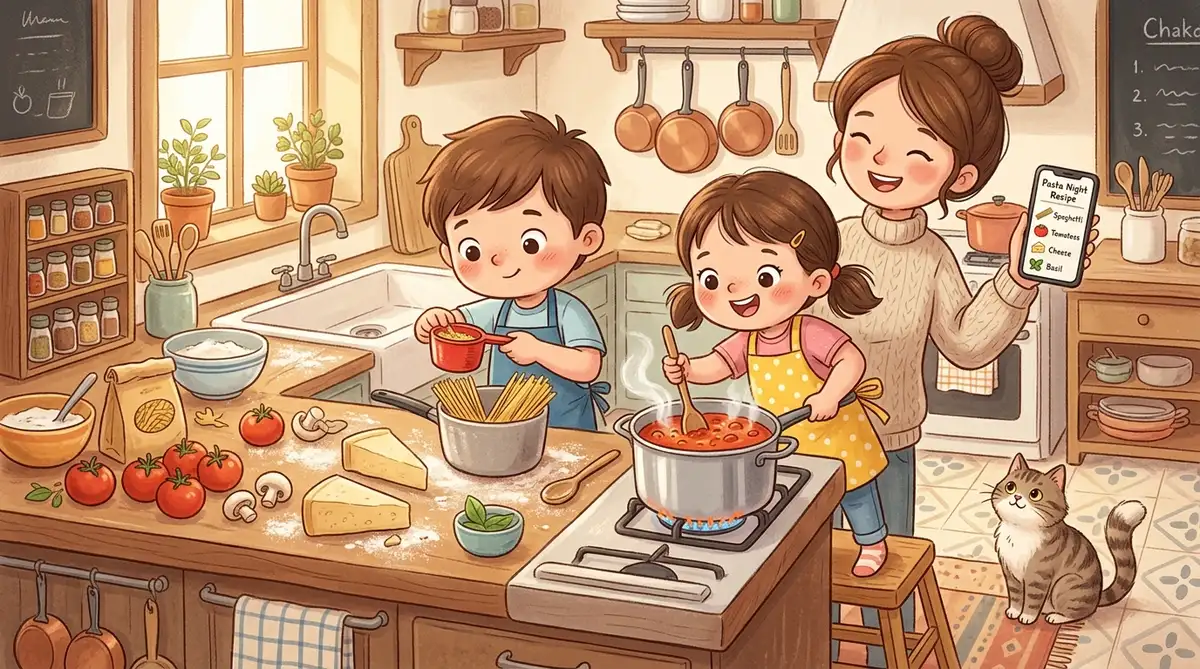
Cooking with kids was my dream. Fantasy: them learning fractions, following steps, becoming independent. Reality: flour everywhere, arguments over who stirs, me rethinking life choices.
The problem: no in-between. Either they watch, or they touch everything and I clean flour from places flour shouldn’t be.
Then I realized AI could solve this in a completely different way: not by giving kids bigger tasks, but by giving them specific, age-appropriate tasks that actually need to happen.
The Problem Nobody Talks About
Cooking with kids isn’t teaching cooking. It’s managing chaos while technically making dinner.
Our son wants to do everything. Our daughter wants to help but can’t read a full recipe. I’m juggling both, trying to keep food edible. Everyone’s frustrated.
So I asked: what if I broke it down into individual tasks matched to what each kid could actually do?
Our son (9, strong reader, likes exact steps): measure, read instructions one at a time, set timer.
Our daughter (8, hands-on, learning to read): mix, stir, pour, press buttons, arrange.
Same kitchen, different tasks. Not improvised. Designed for each of them.
That’s where AI comes in.
The Prompt That Changed Everything
I started simple:
I’m making [MEAL] for dinner. I have a 9-year-old and an 8-year-old. Generate 3-4 specific cooking tasks each can do independently. Tasks should be concrete (not vague), safe, and actually help me finish the meal. For the 9-year-old, include something that involves reading or measuring. For the 8-year-old, include something hands-on and tactile.
Paste that into Claude. Wait 10 seconds. Get back specific tasks.
For pasta night:
Our son: Read out the pasta box directions. Measure the water (use this measuring cup, fill it to the line I show you). Check when the timer goes off.
Our daughter: Stir the pasta once it starts boiling (with the big spoon, I’ll help). Tear up the lettuce for the salad. Press the sauce jar lid (I’ll warm it first).
Suddenly they both have actual jobs. They’re not fighting. I’m not improvising. The meal gets done.
**Your cooking task prompt:**

I'm making [dinner/lunch/snack] for [people]. I have a [AGE]-year-old and a [AGE]-year-old. Generate 3-4 specific cooking tasks each kid can do independently. Make them concrete (not vague), safe, and actually helpful. Include:

For the older child: [something with reading/measuring/following steps]
For the younger child: [something tactile/hands-on]

Add safety tips if needed.

Adjust for your kids' actual ages and abilities.
The Math and Science Sneaking In
You’re not trying to teach math. But math is happening.
Our son measures ingredients, comparing cups and half-cups. Fractions, no flashcards, because the recipe requires it.
Our daughter counts items (put exactly 8 tomatoes on the plate). Number recognition in real context.
Both follow steps (sequence, logic), predict (hot water on dry pasta?), adjust (sauce too thick, add more?).
The cooking is the lesson. No separate lesson plans.
One night: quesadillas. The AI prompt suggested our son calculate pieces per person if we make 4 quesadillas cut into 4 pieces each. He did math that mattered because dinner depended on the answer.
Our daughter learned heat safety, cause and effect (melting cheese), coordination.
- Choose a simple meal (pasta, tacos, sandwiches, quesadillas)
- Write the AI prompt with your kids’ ages and abilities
- Copy the tasks onto a card or paper each kid can see
- Walk them through the first time, then step back
- Let them work while you focus on the cooking parts they can’t do
- Praise the specific task (not just “good job”)
Real Task Examples (So You Don’t Have to Prompt Each Time)
We’ve done this enough that I have a mental library now. Here are actual tasks that worked:
Breakfast (scrambled eggs):
- Older: Measure the milk, check the recipe, tell us when the butter is melted
- Younger: Crack the eggs into the bowl (yes, they’ll get shell sometimes), stir with a fork, tell us when the eggs are done
Lunch (sandwiches):
- Older: Read the list of ingredients, count out bread slices, measure the spread
- Younger: Arrange lettuce and tomato slices, press the sandwich together, cut on the line I drew
Dinner (simple stir-fry):
- Older: Chop the soft vegetables (with a butter knife), measure the sauce, set the timer
- Younger: Stir the pan once it’s on heat, arrange the cooked food on plates, sprinkle the garnish
Snack (nachos):
- Older: Arrange chips on the tray in a single layer, measure the toppings, check when they’re done
- Younger: Sprinkle cheese, tear up toppings, arrange cooked nachos on plates
The pattern: one kid handles prep and measurement. The other handles mixing, stirring, and assembly. Both are real, both matter.
The Real Magic
Your kids start asking to cook. Not because you’re forcing it. Because they’re actually doing something and getting real feedback. The quesadilla turned out great because they followed steps. The salad looks good because they arranged it.
You’re not managing 45 minutes of conflict. You’re cooking 20 minutes with actual help.
Our son asks to make lunch. Our daughter volunteers for snacks. When they ask, I generate new task lists to keep it fresh.
It’s not magical bonding. It’s because they have real jobs and they’re good at them.
When It Falls Apart (And What to Do)
Sometimes a task doesn’t work. Our daughter once got frustrated trying to measure because her hands were too small for the measuring cup. So we switched: she poured, I held the cup. Task evolved, not abandoned.
Our son once got bored with the same pasta prep three times, so we changed the meal completely. Suddenly he was chopping vegetables instead and re-engaged.
If a kid is losing interest, ask: is the task too hard, too easy, or just the same as last time? Adjust that thing, not the whole system.
Why This Matters
Cooking becomes:
- A sequence (steps matter)
- A skill (they can do it)
- Collaborative (both had jobs)
- Practical (this food became dinner)
Not a chore. Not a lesson. Just something people do together.
You get help. Real help. Dinner gets made. Nobody’s frustrated.
This same AI-task approach works for weekly planning, meal planning, and activity planning. Read: Our Sunday AI Routine to see how we automate the whole week in 30 minutes.
Start this week. Pick a simple meal, write the prompt, see what tasks it suggests. Adjust for your kids’ actual abilities, then try it. The first time might be bumpy. By the third time, it’ll be smooth.
Share this article
If this helped, pass it along.