
How Video Games Teach Our Kids More Than School Ever Did
We used to worry about screen time. Every parent does at some point. How much is too much? Are the games rotting their brains? Should we be limiting it more?
Then we flipped the question. Instead of asking “how much screen time,” we started asking “what’s on the screen?”
That changed everything.
The Junk Food Problem (It’s Not About the Screen)
Telling kids they can’t have screen time is like telling them they can’t eat food because junk food exists. The problem was never the food. The problem was what kind of food.
We gave our kids tablets and screens early. But we also filled those screens with good stuff. Educational games. Quality shows. Creative tools. The same way we put fruits and vegetables next to the snacks in the kitchen, we put healthy options next to the entertainment on their screens.
The Screen Time Parallel
We figured if we restricted it, they’d just want it more. That’s how kids work. That’s how most humans work, honestly. So we taught healthy habits instead of enforcing hard limits.
The result? Our kids choose the good stuff on their own now. They pick educational games over mindless ones. They watch science videos because they want to. Nobody has to force it. They developed a taste for it.
Minecraft Is a Math Lab
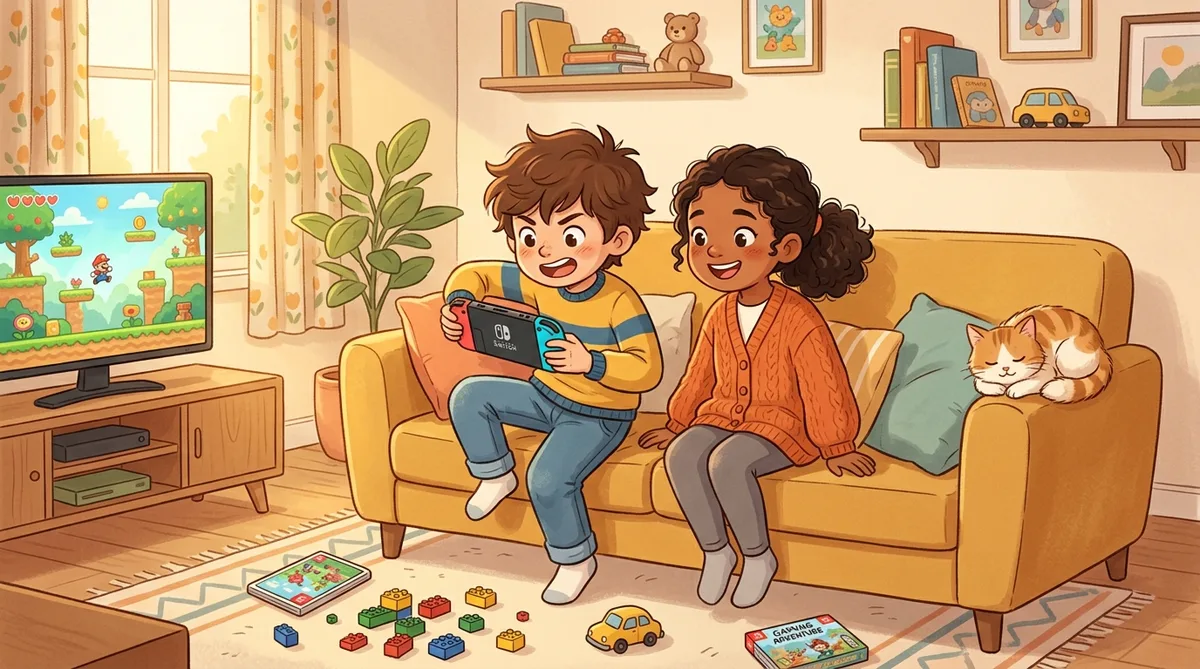
Our son lives in Minecraft. He’s been playing for years on his Nintendo Switch, and we’ve watched him learn things that would take weeks to teach from a workbook.
Redstone circuits taught him basic logic and binary. He didn’t call it binary. He called it “figuring out how the levers work.” Same thing.
Building projects taught him area, perimeter, and ratios. When you need 64 blocks to fill a wall and you only have 40, that’s subtraction with a purpose. When you’re building a symmetrical castle and one side has to mirror the other, that’s spatial reasoning you can see happening in real time.
Resource management taught him planning. You don’t go into the mines without enough torches and food. You calculate what you need before you leave. That’s budgeting, project planning, and risk assessment wrapped in a game about punching trees.
Want the Deep Dive?
Mario Is a Persistence Engine
Both our kids play Mario on the Switch, and the thing that stands out isn’t the hand-eye coordination or the pattern recognition (though those are real). It’s the persistence.
Mario games are hard. You die. A lot. And then you try again. You study the pattern. You adjust your timing. You fail differently. Then you get it.
No tears. No shame. No “I’m bad at this.” Just another try.
Compare that to how most kids react when they get a math problem wrong in a traditional school setting. The emotional weight is completely different. In Mario, failure is just part of the process. Nobody told our kids that. The game taught it through hundreds of attempts, and now they carry that patience into everything else they do.
Dreamlight Valley Is Economics Class
Disney Dreamlight Valley surprised us. It looks like a cute Disney game on the surface. Underneath, it’s a full economic simulator.
Our son spends hours growing crops, harvesting them, and selling them for coins. He has to decide: do I sell the tomatoes now for quick cash, or cook them into a meal that’s worth more? That’s the basic idea behind “buy low, sell high,” and he figured it out on his own.
He budgets his coins to buy items he needs. He plans which crops to plant based on how long they take to grow versus how much they sell for. He’s weighing cost against reward every time he plants a seed, and he’s doing it in his head without anyone teaching him a formula.
Why Disney Games Work
Zelda Is an Open-World Classroom
If Minecraft is a math lab and Dreamlight Valley is economics class, the Legend of Zelda games are the science department. Breath of the Wild and Tears of the Kingdom drop you into a massive world and say “figure it out.”
There’s an economy built on rupees. You collect items, sell them to merchants, and learn what’s valuable versus what’s common. Our son figured out which items to hoard and which to sell before he ever heard the phrase “supply and demand.”
Tears of the Kingdom added a building system where you stick objects together to create vehicles, bridges, and contraptions. That’s engineering and physics experimentation in real time. He builds something, it falls apart, he figures out why, and he redesigns it. Gravity matters. Weight matters. Balance matters.
Sound familiar? That’s the scientific method, just with a sword and a glider.
What We Actually Noticed
When we stopped seeing gaming as the enemy and started watching what the kids were doing, patterns jumped out.
They solve problems without being asked. Not “word problems” from a textbook. Real problems with real stakes in their game worlds. Our son once spent an entire afternoon redesigning a Minecraft redstone door because the timing was off by half a second. That’s debugging, and nobody assigned it.
They teach each other. Our son shows our daughter tricks in games, explains mechanics, and walks her through puzzles. That’s peer tutoring, and he’s patient about it because he remembers figuring it out himself.
They research on their own. When they get stuck, they look up guides, watch tutorials, and read wikis. Nobody assigns this reading. They do it because they want the answer.
They manage frustration. After years of gaming, both kids handle setbacks better than most adults we know. Something doesn’t work? Okay. Try again.
- Watch what your kids actually do during game time (not just how long they play)
- Notice the skills in action: math, reading, problem-solving, persistence
- Ask them to explain what they’re working on in their game
- Look for the learning hiding inside the fun
The Balance (Because Yes, There Is One)
We’re not saying unlimited gaming with zero guidance. Gaming is part of the day, not the whole day. Our kids also do arts and crafts, build with Legos, go geocaching, and spend time outside. Our daughter spends just as much time with scissors and glue sticks as she does with a controller.
The point is that gaming isn’t the enemy. It never was. The enemy is passive, mindless consumption with no engagement. And that’s true for screens, food, and pretty much everything else in life.
When you fill the environment with good options and teach kids to choose well, they surprise you. They pick the educational game over the mindless one. They build elaborate worlds instead of watching someone else play. They learn without anyone telling them to.
Talking to the Skeptics
If you’ve got family members who think gaming is rotting your kids’ brains, we get it. We’ve had that conversation.
The best approach we’ve found: don’t argue the philosophy. Show the results. Let your kid explain their Minecraft build to grandma. Let them describe how the economy works in their favorite game. The learning speaks for itself when kids demonstrate what they know.
One Thing to Try This Week
We wrote about our broader approach to screens in our guilt-free guide to screen time . If this article resonated, that one goes deeper into the philosophy behind how we handle screens in our family.
The games keep teaching. We just had to stop fighting long enough to notice.